
Be Genuine, Be Prepared: Jasper Rassmuson Flint’s Advice for Breaking into Congress
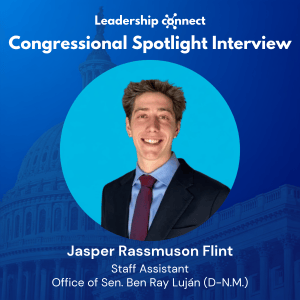 In our Congressional Spotlight series, Leadership Connect sits down with a different Capitol Hill staffer to learn about the person behind the policy work. These conversations explore how staffers built their careers, which policy areas they care about, and what they have learned navigating a work environment unlike any other in the country.
This time, we spoke to Jasper Rassmuson Flint, staff assistant for the Office of Sen. Ben Ray Luján (D-N.M.). He shared how studying abroad and state-level advocacy led to the Senate, his focus on international affairs and AI, and why feedback matters only if you act on it.
Can you walk us through your career path and the steps that led you to your current role as a staff assistant?
Jasper Rassmuson Flint: My path to becoming a staff assistant was unconventional, but I am grateful to have ended up in such a dynamic environment.
Growing up in a multicultural family in the culturally diverse state of New Mexico gave me a deep appreciation for cultural differences. This led me to spend significant time traveling, working, and studying abroad, including earning my bachelor’s degree in international relations in the U.K. During that time, I became interested in public policy as a way to make a positive impact.
Concurrently, I contributed to an AI safety organization and have remained interested in that space since. Policymaking has always been central to enacting change on every issue I studied or cared about.
After studying abroad, I wanted to understand policymaking at home, so I returned to New Mexico to work in state-level advocacy. Writing policy memos and conducting research with Think New Mexico was rewarding, and the work reconnected me with the people working to improve my home state.
But after years of following national politics from a distance, first from across the Atlantic and then from New Mexico, I wanted a closer look. I landed an internship in Luján’s office and was fortunate to be kept on full time as a staff assistant.

What advice would you offer to individuals aiming to work in Congress, and how can they stand out in such a competitive environment?
Jasper Rassmuson Flint: Network. Staffers are generous with their time, and a conversation with one can clarify your goals, show you how to reach them, and sometimes help move your application forward. Remote chats work, but in-person meetings on the Hill are better because they leave a stronger impression. Rather than worrying about standing out, focus on being genuine and well prepared: know the member’s work, ask thoughtful questions, and follow up promptly.
Which policy areas or legislative issues are you most passionate about, and how do you stay informed and engaged in those specific areas?
Jasper Rassmuson Flint: I’m most interested in international affairs and AI. As someone raised in a family shaped by the transatlantic alliance, I care deeply about how that partnership evolves. I stay informed by reading Foreign Affairs, attending lectures around DC, and learning from the sharp colleagues I work alongside.
On AI, I’m drawn to export controls and alignment research, which sit at the intersection of national security and technology policy. CSIS’s AI Policy Podcast is my go-to for keeping up with those conversations.

Tell us about a project that shaped your growth as a staffer. What challenges did you face, and what did you learn?
Jasper Rassmuson Flint: In exit interviews, my first cohort of interns told me they found the slower stretches of the Senate schedule unengaging. Slow periods are part of this work, but I took the feedback seriously.
I talked with intern coordinators in other offices, thought through what had and hadn’t worked, and designed a capstone assignment: each intern picks a policy area they care about and produces a deliverable over the course of the internship. The assignment keeps interns engaged during recess, lets them dive deep on a topic they’re passionate about, and gives them a work product to show future employers.
Building that program taught me that feedback only matters if you act on it, and that acting on it usually means persuading other people to come along. I had to make the case to my supervisors, borrow ideas from other offices, and check back with former interns on whether the changes would have helped.
Building the program also gave me more confidence to propose improvements instead of waiting to be asked.
What sets Capitol Hill apart as a unique work environment? How do you navigate its challenges every day?
Jasper Rassmuson Flint: Two words: responsibility and management. Managing interns in my first job has been a unique experience. Real responsibility at the entry level is common on the Hill, but it’s still worth appreciating.
Young professionals prioritize building skills, connections, and credentials, and an environment that entrusts early-career staffers with meaningful work accelerates all three. Doing something for the first time can be daunting, but I’ve found that colleagues who were in my position not long ago are always willing to share advice.
Word association – What is the first word that comes to mind for each of these?
Policy: Consequential
Networking: Growth
Writing Skills: Valuable
Working on the Hill: Exciting
Leadership Connect: Clever
To be featured or learn more, reach out to Gabi Thomas and spread the word to any colleagues who would be interested.
Be sure to follow our LinkedIn page for more news and to see all of our featured staffers!